Showing posts with label God's power. Show all posts

Tuesday, July 22, 2025

Freedom to Reject, Mercy to Warn


"Freedom to Reject, Mercy to Warn"

Text: Exodus 8:20–9:12


We stand in awe of the mighty works of God—His wonders in the heavens, His miracles on earth, and His supreme authority over all creation. Yet, Exodus 8:20–9:12 shows us a sobering reality: even in the face of overwhelming divine power, human hearts can remain stubborn, hardened, and defiant. In these passages, God sends plague after plague, each one revealing not only His power but also His mercy, warning Pharaoh and Egypt again and again. But Pharaoh chooses to reject God.

Today, we’ll explore this truth: however great may be the manifestations of God's glory, humanity still has the freedom to reject Him. We'll see how this applies to us today—and why we must guard our hearts from pride and hardness.


The Plagues: God's Power Unleashed

Exodus 8:20–9:12 covers the fourth through sixth plagues:

  • Plague of Flies (8:20–32): A swarm of flies fills the Egyptian homes and land, except in Goshen, where God's people live—God shows His ability to distinguish between His people and the world.

  • Plague on Livestock (9:1–7): A deadly pestilence wipes out Egypt’s livestock, again sparing the animals of Israel.

  • Plague of Boils (9:8–12): Painful boils break out on both humans and animals. Even the Egyptian magicians cannot stand before Moses.

These judgments are not random—they are deliberate attacks on Egypt’s gods:

  • Uatchit, goddess of the fly—rendered powerless by Yahweh's plague.

  • Hathor, goddess of love and protector of cattle—unable to stop the pestilence.

  • Imhotep, god of medicine—powerless to heal or protect the people.

  • Even the magicians, seen as intermediaries of divine power, were brought low by the boils.

Each plague dismantles Egypt’s false religion and shows Yahweh as the one true God. Yet despite all this, Pharaoh hardens his heart.


Free Will in the Face of God's Glory

This story shows us a profound and often painful truth: God does not force obedience.

God showed Pharaoh His power, His justice, and His ability to protect His people—but Pharaoh still had the freedom to say "No." He saw miracles with his own eyes. He heard warnings from God’s prophet. He even witnessed mercy, like when God removed the plagues at Pharaoh's request. Still, Pharaoh refused to surrender.

This freedom to reject God is one of the most mysterious aspects of human responsibility. We ask, “Why wouldn’t someone believe after seeing such signs?” But the answer lies not in the eyes, but in the heart.

Proverbs 4:23 says, “Above all else, guard your heart, for everything you do flows from it.”


Guarding Our Hearts

If Pharaoh’s heart could harden under divine light, then we too must be cautious. Hardened hearts aren’t always loud and angry—they can become crusted over slowly through pride, comfort, distraction, or fear.

Here’s how we guard our hearts:

  1. Stay humble before God. Pharaoh's pride made him blind. Humility opens the door to God's correction.

  2. Don’t delay obedience. Pharaoh delayed and negotiated with God. We must act when God speaks.

  3. Examine your response to correction. Do we resist conviction, or repent and change?

  4. Remember God’s mercy. Each plague could have been final—but God gave Pharaoh chance after chance. God is merciful, but His patience is not eternal.


A Warning and a Hope

The story is a warning: you can see God's power and still reject Him. But it's also an invitation: you can turn to Him today. The same God who judged Egypt is the One who sent His Son to bear judgment in our place.

Hebrews 3:15 warns us:

“Today, if you hear his voice, do not harden your hearts.”

God still speaks. He still calls. He still warns. But we must listen.


How Will You Respond?

Pharaoh serves as a mirror for all of us. The question is not whether God is real, or whether He speaks—the question is, how will we respond when He does?

Let’s not wait for life to fall apart to finally bow. Let’s not demand signs and wonders, when we already have the cross, the resurrection, and the Holy Spirit. Let us guard our hearts, walk in humble obedience, and say, “Yes, Lord,” when He calls. Amen.

More: Sabbath School EXODUS Lesson 4 - The Plagues


Monday, July 14, 2025

God's Promises in the Midst of Pain


"God's Promises in the Midst of Pain"

Text: Exodus 5:22–6:8

Have you ever obeyed God, only to find that things got worse instead of better? That’s exactly what Moses experienced. After bravely confronting Pharaoh with God's demand, “Let my people go,” Pharaoh increased the Israelites' burdens. The people turned against Moses, and in his discouragement, Moses turned to God and asked, “Why, Lord? Why have you brought trouble on this people?” (Exodus 5:22).

God’s answer in Exodus 6:1–8 is one of the most theologically rich declarations in all of Scripture. In response to Moses’ discouragement, God doesn’t rebuke him. Instead, He reveals Himself through powerful promises and deep truths. These verses are filled with divine “I” statements that show us not only who God is, but what He does for His people.


God's Response: Reassurance, Not Rejection (Exodus 6:1)

“Now you will see what I will do to Pharaoh…”

God doesn’t dismiss Moses’ frustration. He patiently explains that Pharaoh’s defiance is not a sign of God's weakness, but part of the bigger plan. God will act in power. Pharaoh’s arrogance will become the platform for God's glory.

This reminds us: God’s timing is perfect, even when His ways are painful. The delay is not denial—it’s preparation.


God's Identity: "I Am the LORD" (Exodus 6:2, 6, 7, 8)

“I am the LORD.”

This phrase is repeated four times in these verses. In Hebrew, it’s “Yahweh,” the covenant name of God. It signals His unchanging, self-existent nature. He is not just a distant deity—He is the God of Abraham, Isaac, and Jacob. He remembers His covenant and He is faithful to it.

When we question God’s plan, we must return to who God is.
He is not just a helper; He is the LORD.


God's Promises: The Seven “I Will” Statements

God responds to Moses' despair with promises, not explanations. There are seven "I will" statements in Exodus 6:6–8 that form the foundation of God's redemptive plan:

  1. “I will bring you out” (v.6) – Deliverance from external oppression.

  2. “I will free you from being slaves” (v.6) – Internal liberation from slavery’s identity.

  3. “I will redeem you with an outstretched arm…” (v.6) – God will pay the price and display His power.

  4. “I will take you as my own people” (v.7) – He desires a relationship, not just rescue.

  5. “I will be your God” (v.7) – Covenant intimacy. They will belong to Him.

  6. “I will bring you to the land…” (v.8) – He has a destination in mind.

  7. “I will give it to you as a possession” (v.8) – God's gift is lasting and secure.

Each of these statements points to God's initiative, God's faithfulness, and God's desire for relationship.


Theological Truths Revealed:

  1. God is a covenant-keeping God.
    He remembers what He has promised—even when we forget or doubt.

  2. God’s identity is the foundation of our hope.
    “I am the LORD” anchors every promise in His unchanging nature.

  3. God’s redemptive plan is both physical and spiritual.
    He doesn't just free Israel from slavery; He calls them His people. Likewise, God saves us not just from sin’s penalty, but into a relationship with Him.

  4. God acts for His glory and our good.
    Pharaoh’s resistance would become the means by which God’s mighty hand would be known.


When Moses questioned God, the Lord didn't give a strategy—He gave a revelation. He showed Moses who He is and what He will do.

So, when you are weary from waiting, confused by suffering, or feeling forgotten—go back to God's promises. Remember the “I am” and rest in the “I will.” His power is certain. His plan is unfolding. His promises are sure.

“I am the LORD.” That is enough.


Now it's Your Turn:

  1. Which of God's “I will” promises do you most need to remember today?

  2. Are you trusting more in God’s character or in your own understanding?

  3. How can you encourage someone else who feels like Moses—tired, confused, and discouraged?

Let this passage remind you: God’s promises do not fail, even when circumstances look like they have.


More: Sabbath School Lesson 3 - Rough Start


Tuesday, July 8, 2025

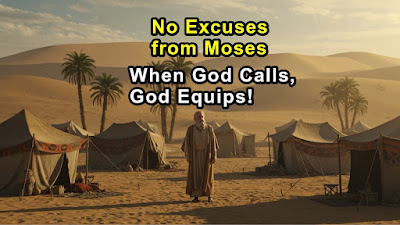
The Excuses of Moses: When God Calls, He Equips


"When God Calls, He Equips"

Text: Exodus 4:1–17

Have you ever felt inadequate for a task you knew was important—maybe something you believed God was asking you to do? Maybe you’ve had a sense of calling but felt overwhelmed by your weaknesses. If so, you are in good company. Moses, one of the most revered leaders in the Bible, experienced this same inner struggle in Exodus 4:1–17. Here, we see a conversation between God and Moses that reveals both human hesitation and divine patience.


The Excuses of Moses (Exodus 4:1, 10, 13)

God had already called Moses in Exodus 3, but here in chapter 4, Moses begins to push back. He gives three excuses:

  1. "They won’t believe me" (v.1) – Moses feared rejection, doubting that the Israelites would believe that God had sent him.

  2. "I’m not eloquent" (v.10) – Moses focused on his perceived weakness—his lack of speaking ability, whether due to a speech impediment or insecurity.

  3. "Please send someone else" (v.13) – Ultimately, Moses just didn’t want to go. He doubted himself—and, indirectly, doubted God.

These excuses are not unfamiliar to us. We, too, fear rejection, feel underqualified, or just want someone else to do what God is asking of us.


The Signs God Gave (Exodus 4:2–9)

To assure Moses, God gives three miraculous signs:

  1. The staff turns into a snake and back (vv.2–4) – Symbolizing God's power over nature and fear, and Moses' authority.

  2. His hand becomes leprous and is healed (vv.6–7) – A sign of God's power to afflict and restore; a reminder that God controls even our bodies.

  3. Water from the Nile turns to blood (v.9) – A powerful warning and sign of judgment, especially against Egypt's gods.

Each sign was not just for show but carried spiritual weight. These miracles were designed to affirm that the God of their ancestors was truly at work through Moses.


God’s Response to Moses' Insecurity (vv.11–12)

When Moses says he’s not a good speaker, God answers with a powerful question:

“Who gave human beings their mouths? Who makes them deaf or mute? ... Is it not I, the Lord?” (v.11)

In other words, “I know your limitations better than you do—and I’m still calling you.”

God promises, “I will help you speak and will teach you what to say” (v.12). What grace! But even then, Moses resists, and finally God becomes angry—not because Moses was weak, but because Moses was unwilling to trust.

Still, God doesn’t abandon him. Instead, He offers Aaron, Moses’ brother, to go with him and be his spokesman. God adapts to Moses’ weakness but doesn’t remove the call.


Lessons for Us

  1. God knows our weaknesses—but still calls us.
    He doesn’t wait for perfect people. He uses the willing, not just the qualified.

  2. God equips those He calls.
    He provides signs, help, words, and people—whatever is needed to carry out His will.

  3. Excuses rob us of experiencing God’s power.
    Fear is natural, but faith must respond. God is patient, but He expects obedience.

  4. God’s call is about His power, not our ability.
    When we focus on our inadequacies, we forget the One who empowers us. God didn’t need Moses to be perfect—He needed him to trust.

Maybe you, like Moses, are wrestling with God’s call in your life. Maybe you feel too weak, too afraid, too imperfect. But God still says, “Go.” And He promises, “I will be with you.”

Don’t let fear stop you from following God’s purpose. Trust Him. Step forward in faith. Because when God calls, He doesn’t just send you—He goes with you. Amen!

More: EXODUS - Sabbath School Lesson 2 - The Burning Bush