Showing posts with label Mark. Show all posts

Wednesday, July 17, 2024

The Unpardonable Sin


Mark 3:28–30 states:

 "Truly I tell you, people can be forgiven all their sins and every slander they utter, but whoever blasphemes against the Holy Spirit will never be forgiven; they are guilty of an eternal sin.” He said this because they were saying, “He has an impure spirit.” (NIV)


The unpardonable sin, according to these verses, is blasphemy against the Holy Spirit. In the context of this passage, Jesus is responding to the accusations made by the Pharisees that He is casting out demons by the power of an evil spirit (specifically, Beelzebul, a name used for Satan). Essentially, they are attributing the work of the Holy Spirit, who empowers Jesus to perform miracles and cast out demons, to Satan.


Meaning and Implications


Blasphemy Against the Holy Spirit:

   - Definition: Blasphemy against the Holy Spirit involves a deliberate and persistent rejection and attributing the works of the Holy Spirit to evil. It is not a single act of disbelief or doubt but an ongoing, hardened stance against the divine work and truth of the Holy Spirit.

   - Context: Jesus was performing miracles by the power of the Holy Spirit, and the Pharisees were willfully and knowingly denying this and attributing His power to Satan. This deliberate misattribution and rejection of the Spirit’s work is the essence of the unpardonable sin.


Eternal Consequence:

   - Unforgivable Nature: This sin is described as unforgivable because it represents a complete and utter rejection of the grace and work of God, cutting oneself off from the only means of salvation. If a person continually rejects the Holy Spirit's testimony about Jesus, they cannot be forgiven because they refuse the means by which forgiveness is given.

   - Heart Attitude: The unpardonable sin reflects a heart that is so hardened and opposed to God that it will not repent or seek forgiveness. This is not about occasional doubts or sins but a deep-seated and persistent opposition to the Holy Spirit's work.


Practical Understanding


For most believers, anxiety about having committed the unpardonable sin is a sign that they have not, because their concern indicates a softness of heart and openness to God's conviction and forgiveness. The unpardonable sin is characterized by a complete and hardened rejection of God’s work and grace, which leads to a state where forgiveness is no longer sought or desired.


Sunday, July 14, 2024

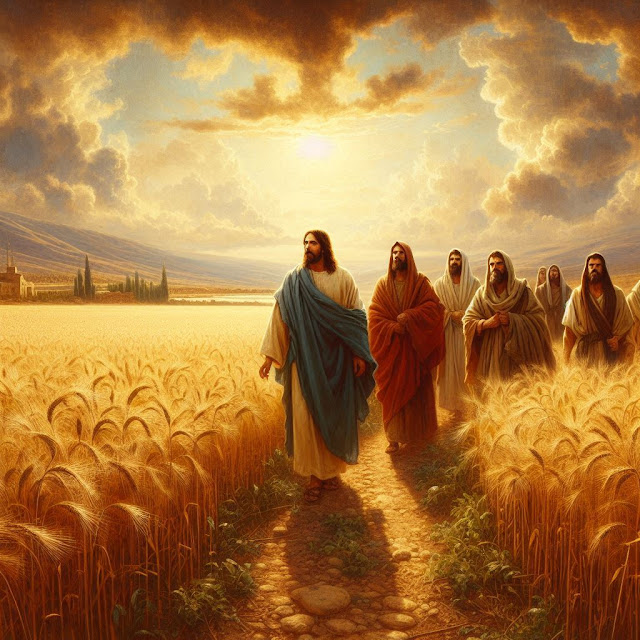
The Disciples Gathering Grain on the Sabbath


It must be noted that Jesus Himself is not recorded as gathering grain. It was only His disciples.

Why were they even walking through a grain field on the Sabbath? We have a hint as to why this was the case. In Mark 3, the family of Jesus confronts Him. They question His mental state as not even stopping to eat in what seemed to be His nonstop ministry.

It could be that they were taking advantage of "fast food." Walking and gathering grain was a way to eat on the run. This was probably not the first instance of them eating while traveling, although no other mention is made of it.

The story of Jesus' disciples gathering grain on the Sabbath is found in the New Testament of the Bible, specifically in the Gospels of Matthew (12:1-8), Mark (2:23-28), and Luke (6:1-5). According to these accounts, the disciples were picking heads of grain and eating them because they were hungry.

This act raised controversy because it was the Sabbath, a day on which Jewish law prohibited work. The Pharisees, a group of Jewish religious leaders, questioned Jesus about why his disciples were doing what was considered unlawful on the Sabbath.

Jesus responded by referring to an incident involving David, a revered figure in Jewish history. When David and his companions were hungry, they ate the consecrated bread from the house of God, which was lawful only for priests to eat (1 Samuel 21:1-6). Jesus used this example to illustrate that human need can take precedence over ceremonial law. He also stated that "the Son of Man is Lord of the Sabbath," emphasizing his authority to interpret the Sabbath law.

The disciples were gathering grain on the Sabbath because they were hungry, and Jesus used the situation to teach about the purpose of the Sabbath and His authority over it.


Friday, June 28, 2024

Who Was John Mark?


John Mark, often referred to simply as Mark, is a significant figure in the New Testament of the Bible. Here are some key points about his story:

  1. Early Ministry and Travels: John Mark first appears in the Book of Acts. He accompanied Paul and Barnabas on their first missionary journey (Acts 12:25, 13:5). However, he left them partway through the journey and returned to Jerusalem (Acts 13:13), which caused some contention between Paul and Barnabas.

  2. Separation from Paul: When planning a second missionary journey, Paul refused to take John Mark along because he had abandoned them previously. This led to a sharp disagreement between Paul and Barnabas, resulting in their separation. Barnabas took John Mark with him to Cyprus, while Paul chose Silas as his companion (Acts 15:36-41).

  3. Reconciliation with Paul: Despite their earlier disagreement, Paul later acknowledged John Mark's usefulness in ministry. In his letters, Paul speaks positively about him. In Colossians 4:10, Paul refers to Mark as a valuable helper, and in 2 Timothy 4:11, Paul requests Mark's presence, saying, "he is helpful to me in my ministry."

  4. Association with Peter: John Mark is also closely associated with the Apostle Peter. In 1 Peter 5:13, Peter refers to Mark as his "son," indicating a close mentor-mentee relationship. This connection is significant because it is traditionally believed that Mark wrote the Gospel of Mark based on Peter's teachings and experiences.

  5. Author of the Gospel of Mark: Mark is traditionally credited with writing the second Gospel in the New Testament. The Gospel of Mark is believed to be one of the earliest written accounts of Jesus' life and ministry and is noted for its concise and straightforward style.

Through these events, John Mark's story in the Bible is one of initial failure, subsequent growth, reconciliation, and significant contribution to the early Christian church.