
Posts

Showing posts from September 1, 2024

The Annointing at Bethany and The Betrayal: Mark 14:1-11
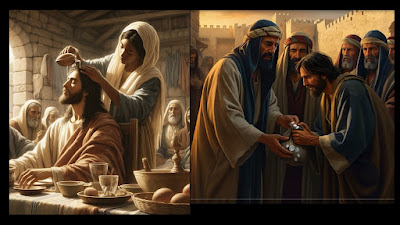
  In Mark 14:1–11, two key events are described:  The Anointing at Bethany (Mark 14:3–9) Jesus is in Bethany at the house of Simon the Leper. During a meal, a woman comes in with an alabaster jar of very expensive perfume made of pure nard. She breaks the jar and pours the perfume on Jesus’ head, anointing him. Some of the people present criticize her, saying the perfume could have been sold and the money given to the poor. Jesus defends the woman, saying she has done a beautiful thing in preparing his body for burial ahead of time. He says that her act will be remembered wherever the gospel is preached.  Judas’ Betrayal (Mark 14:10–11) After this, Judas Iscariot, one of Jesus' twelve disciples, goes to the chief priests and offers to betray Jesus to them. The chief priests are pleased and promise to give Judas money. From that point on, Judas looks for an opportunity to hand Jesus over to them. Contrasting the Two People In Mark 14:1–11, the anointing of Jesus by the wom...

Christians Should Avoid Getting Caught Up In Predictions About The Return of Jesus

  "What signs of Christ’s coming especially stand out to you in  the present world?" (pg. 86, The Book of Mark, 3rd qtr. 2024) Some have been telling people signs of Jesus' return for hundreds of years. Some people alive 180 years ago thought the signs pointed to the return in 1843, then 1844. Then every couple of  years after that. We have been preaching a Sunday Law for more years than Noah preached the flood. (That is a paraphrase quote from Danny Shelton, 3ABN is his sermon We are not the True Church:  https://www.youtube.com/watch?v=G5YauNeRt00&t=3595s That does not mean it's not going to happen, but we need to stop crying wolf for every world and local event. Christians can avoid getting caught up in predictions about the return of Jesus by focusing on the core teachings of their faith rather than speculating about future events.  Trust in God's Timing Jesus himself emphasized that no one knows the day or hour of His return (Matthew 24:36). Christians...

Beware of False Prophets Jesus Warned us about in Mark 13:22

  To be a Christian and avoid false prophets, it’s important to be grounded in your faith, understand biblical teachings, and be discerning.  The Adventist Church at the moment is proliferating with self-appointed prophets. The pandemic helped usher in a new wave of conspiracy theories and false teachings. Sadly, many of them remain popular in Adventist circles. You see them on youtube and they peddle a variety of seminars, promising to give you the latest and greatest. Everything in the news is ripe for a new prophecy. We will not name names, but hope you know exactly who we are talking about. None of what they say ever comes true, and they only comment on an event AFTER it happens. A well-known Adventist author once said that they do this because they need to keep the money flowing in. Here are some principles to guide you. Know the Bible Study Scripture: Knowing the Bible helps you recognize teachings that contradict its core messages. False prophets often distort or misin...

Sabbath School Lesson 11: Taken and Tried

  The Book of Mark Sabbath School Lesson 11 Taken and Tried You may use this for presenting and studying the current Sabbath School Lesson. ------------------------------ >   Download the notes for Lesson 11 video here. ----------------------  >  Download  Mark (3rd qtr) Sabbath School Lessons Here ------------------------------

The Great Tribulation: Mark 13:19

  The Great Tribulation: Mark 13:19 What tribulation is Jesus referring to? Many believe this was the persecution during the Middle Ages and during the early church. Or the fall of Jerusalem in AD 70. Both of those fall short of what the Bible text says. In Mark 13:20, Jesus shifts to times that are clearly not AD 70 nor the Middle Ages. We know that because of verse 22.  Mark 13:22 NIV "For false messiahs and false prophets will appear and perform signs and wonders to deceive, if possible, even the elect." This parallels the narrative of Revelation shortly before Jesus comes. Mark 13:24-26 NIV “But in those days, following that distress, “‘the sun will be darkened,     and the moon will not give its light; the stars will fall from the sky,     and the heavenly bodies will be shaken.’ “At that time people will see the Son of Man coming in clouds with great power and glory." It is easy to understand this is a future event that has not happened yet. These thi...

The "Anointed One" and the "Prince who is to Come: Daniel 9:26-27

  In Daniel 9:26-27, the identities of the "anointed one" and the "prince who is to come" have been the subject of various interpretations, depending on theological perspectives. Here's the passage: Daniel 9:26-27 (ESV): "And after the sixty-two weeks, an anointed one shall be cut off and shall have nothing. And the people of the prince who is to come shall destroy the city and the sanctuary. Its end shall come with a flood, and to the end there shall be war. Desolations are decreed. And he shall make a strong covenant with many for one week, and for half of the week he shall put an end to sacrifice and offering. And on the wing of abominations shall come one who makes desolate, until the decreed end is poured out on the desolator." Interpretations: The Anointed One: Traditional Christian Interpretation: Many Christian scholars identify the "anointed one" as Jesus Christ. The term "anointed" (which translates to "Messiah" ...

The Abomination of Desolation:Mark 13:14–18

 In Mark 13:14-18, Jesus provides a clue about the "abomination of desolation" by referencing a specific prophecy from the Book of Daniel. Here's the passage: Mark 13:14-18 (ESV): “But when you see the abomination of desolation standing where it ought not to be (let the reader understand), then let those who are in Judea flee to the mountains. Let the one who is on the housetop not go down, nor enter his house, to take anything out, and let the one who is in the field not turn back to take his cloak. And alas for women who are pregnant and for those who are nursing infants in those days! Pray that it may not happen in winter.”  Key Clue: Reference to Daniel: The phrase "abomination of desolation" is a direct reference to prophecies found in the Book of Daniel (specifically Daniel 9:27, 11:31, and 12:11). In these passages, Daniel describes an event where something sacrilegious would be set up in the holy place, causing desolation. Implication: Historical Contex...

Not One Stone on Another: Mark 13:1-13

In Mark 13:1–13, the disciples' response and Jesus' answer carry deep theological and prophetic significance to the destruction of the temple in Jerusalem. The Disciples' Response (Mark 13:1-2): As Jesus and His disciples were leaving the temple, one of His disciples remarked on the magnificence of the temple, specifically its large stones and impressive buildings. This reflects their awe at the grandeur of the temple, which was the center of Jewish worship and national identity. Disciples' Statement   "Look, Teacher! What massive stones! What magnificent buildings!" (NIV) Jesus’ Response (Mark 13:2): Jesus responds to the disciple’s admiration with a prophetic statement. "Do you see all these great buildings? Not one stone here will be left on another; every one will be thrown down." (NIV) Significance of Jesus’ Response Prophecy of Destruction: Jesus predicts the destruction of the temple, which historically occurred in AD 70 when the Romans dest...

Lessons from the Widow's Offering: Mark 12:41-44

  In Mark 12:41–44, the account of the widow's offering is described as follows:  The Widow's Offering Amount Given The widow gave two small copper coins, known as "mites" or "lepta." These were of very little monetary value, equivalent to a fraction of a penny. Jesus' Response: Jesus observed people putting money into the temple treasury and noticed the poor widow's offering. He called His disciples and said, "Truly I tell you, this poor widow has put more into the treasury than all the others. They all gave out of their wealth; but she, out of her poverty, put in everything—all she had to live on." (NIV) Lessons from the Passage True Generosity The widow's offering demonstrates that true generosity is measured not by the amount given, but by the heart and sacrifice behind it. Jesus commended the widow not because she gave a large sum, but because she gave all that she had, showing complete trust in God. Sacrificial Giving The widow...